Iran’s Revolutionary Guard Navy said three oil tankers exploded after striking naval mines in the Strait of Hormuz. The claim came in a news report relayed on X by @clashreport at 10:14 UTC on November 3.
The report said the tankers had allegedly switched off their navigation and identification systems. It named no vessels, flags, owners or casualties.
CrisisTape has not confirmed the explosions, the mine claim or the tankers’ transponder status. We found no shipping agency, vessel operator or government that corroborates the account.
Why Hormuz matters
The Strait of Hormuz is the narrow waterway between Iran and Oman that links the Gulf to the open sea. It is a main export route for Gulf oil, so any disruption there draws attention from crude traders.
Mining and tanker attacks in the area have a long history, most notably during the 1980s tanker war.
Ships that switch off their identification systems are hard to track. That makes it difficult for outside observers to confirm where an incident happened or who was involved.
Market reaction
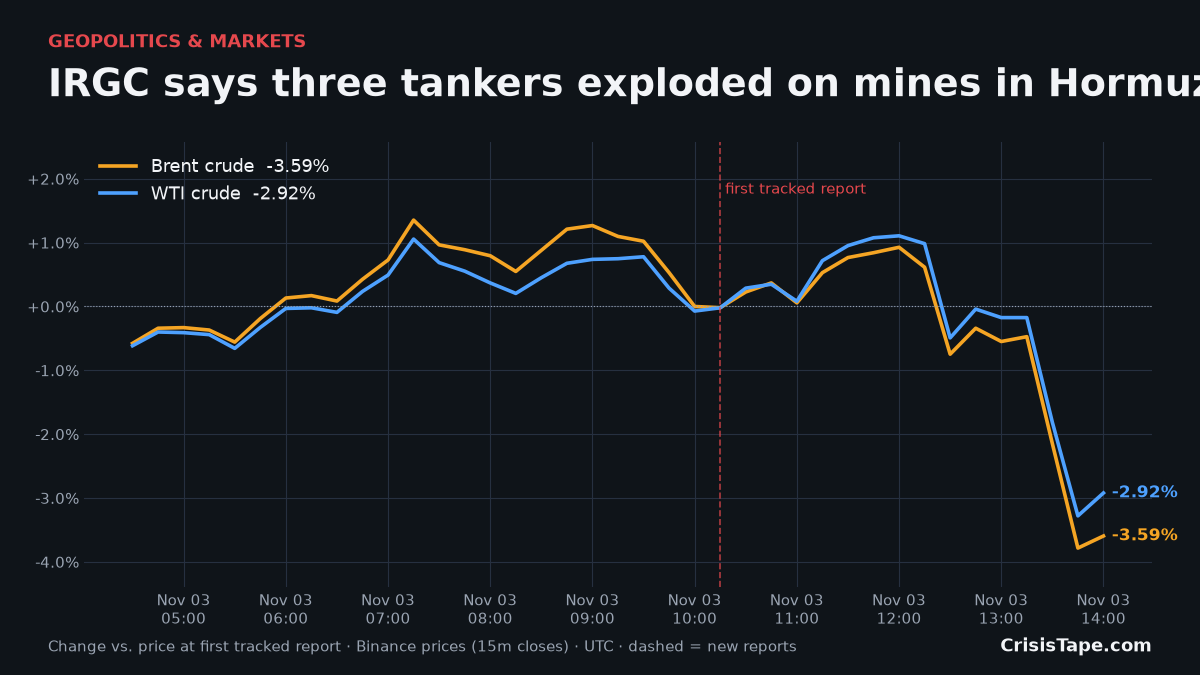
| Market | At first tracked report | +1h | +4h | Latest |
|---|---|---|---|---|
| WTI crude | 97.58 Nov 03 10:14 UTC | +0.71% | — | -0.92% Nov 03 15:18 UTC |
| Brent crude | 105.72 Nov 03 10:14 UTC | +0.53% | — | -1.28% Nov 03 15:18 UTC |
| Gold | 3,915.23 Nov 03 10:14 UTC | +0.07% | — | +0.64% Nov 03 15:18 UTC |
| Bitcoin | 77,001.80 Nov 03 10:14 UTC | +0.22% | — | +0.34% Nov 03 15:18 UTC |
WTI, priced on Binance’s USD-M perpetual contract, rose 0.71% in the first hour after the reports surfaced. That gain did not last. Since the first reports, it has fallen 0.92%, to 96.68 at 15:18 UTC.
Brent followed the same path and then some. It fell 1.28% since the first reports, which shows the early spike was not sustained.
Reading the reaction
The fade matters more than the spike. A single-source claim from a party to the conflict, with no vessels named, gave traders little to price. The reversal suggests the market did not treat it as a confirmed loss of supply.
If the explosions are confirmed, the first effects would likely show up in war-risk insurance and tanker routing rather than in lost barrels. That is our inference. It depends on how many ships and cargoes were involved, which is still unknown.
What to watch next
- Independent confirmation of the explosions from maritime security agencies, vessel operators or flag states.
- Vessel names, tracking data or casualty reports that would tie the claim to specific ships.
- Further statements from the IRGC, Iran’s government or other governments in the region.
- Whether crude’s early gains return, and how the Brent-WTI spread moves in the next session.
- Changes in war-risk insurance quotes and in tanker traffic through the strait.
Sources
- @clashreport (news report)
This article is for information and commentary only and is not financial or investment advice. Posts quoted from X are attributed to their authors; claims from state-affiliated or unverified accounts are labelled as such and may not be independently confirmed.